


Every learning pathway starts with discovering a learning opportunity: before a learner can enrol, study, and earn a degree or micro-credential, they need to find the programme or course that matches their needs and career goals.
Hence it's no surprise that the first and foremost use case ("Discover") in the Higher Education Interoperability Framework (HEIF) is about exchanging rich, structured data on learning opportunities between education institutions. This will allow learners to find courses across institutional and national borders.
Joint course catalogues are also on the agenda of virtually all European Universities alliances. The question of how to share such data efficiently and reliably is thus pressing for many institutions around Europe.
Four main standards in Europe
The task force on data models and APIs used the comprehensive HEIF reports, e.g. the mapping report, as its starting point and looked further into the standards that are currently used by higher education institutions and alliances to describe and exchange data on learning opportunities.
Many global, European, and national standards exist and are in use, but four stood out as the most widely used across Europe:
Based on a detailed mapping exercise covering these four, the task force produced two practical resources for higher education institutions and alliances:
Overview table, comparing the main features of each standard
Detailed property mapping against the ECTS course catalogue format
These resources give institutions a common reference point for translating between the different standards if needed, e.g. if several standards are in use within one alliance.
The task force also mapped the controlled lists/vocabularies used across the standards. This is essential for data to mean the same wherever it travels, and to avoid loosing precision when converting from one standard to another.
Building on existing work
Fortunately, the task force did not have to start from scratch. It was able to draw on a number of existing initiatives and their outputs, such as:
- the QualityLink ontology mapping
- the DACEM project
- the DC4EU converters
- the open-source credential converter
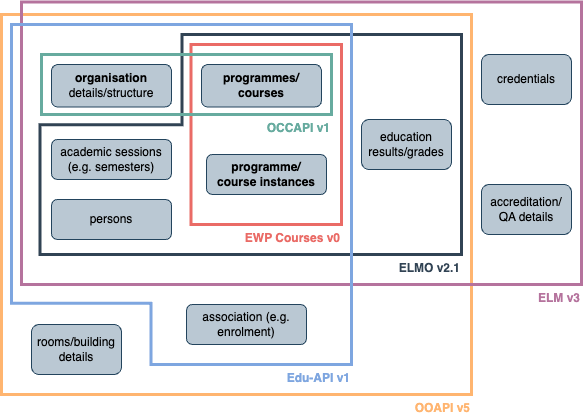
(source: QualityLink - license: CC BY)
By connecting these efforts and reusing existing mappings and resources, the task force aimed to support institutions and alliances when choosing, implementing, and bridging different standards. A step towards seamless cross-border course discovery, to give learners access to a greater variety of learning opportunities and pathways matching their needs.
Please log in or sign up to comment.